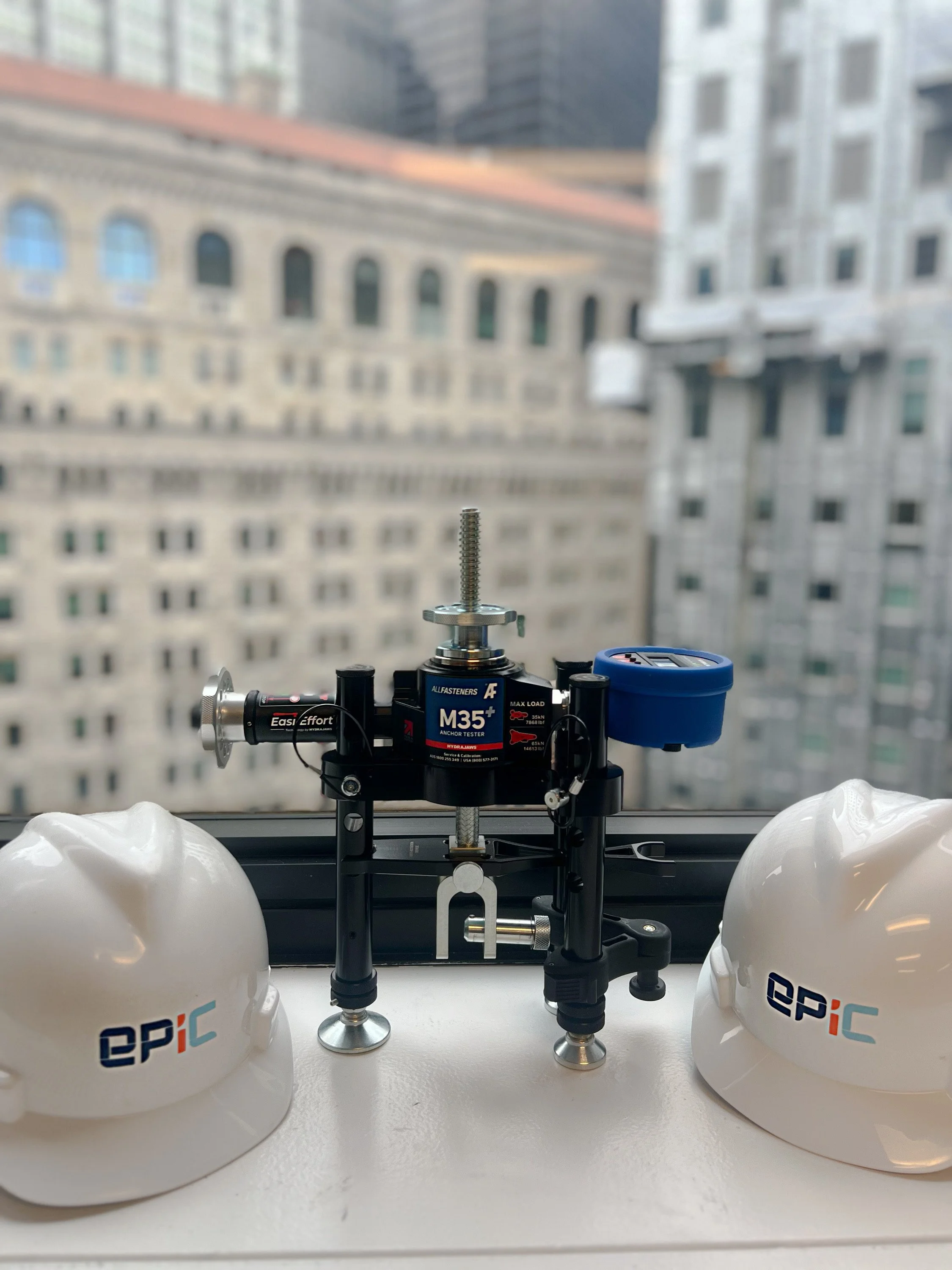
EPIC Expands Services with In-House Anchor Pull Testing
Equipment Spotlight: HYDRAJAWS® M35+
EPIC's newest testing equipment provides:
· Testing capability for anchors ranging from 1/4" to 3/4" diameter
· Digital load measurement and recording
· Calibrated equipment for Special Inspection applications
· Testing capacity up to 35 kN (approximately 7,868 lbs)
· Portable design for use on active construction sites
· Reliable proof load testing for post-installed anchor installations
As construction projects continue to rely on post-installed anchors for structural, architectural, and MEP applications, verification of anchor performance has become an increasingly important part of quality control and Special Inspection programs.
In a previous EPIC Knows article, we discussed the inspection requirements for post-installed anchors, including ICC-ES accreditation, installation procedures, and the requirements of NYC Building Code Section 1705.37. This month, we're focusing on another important aspect of anchor compliance: proof load testing, commonly referred to as anchor pull testing.
What Is Anchor Pull Testing?
Anchor pull testing is performed to verify that an installed anchor can safely resist the loads for which it was designed. During testing, a controlled tensile force is applied to the anchor using calibrated hydraulic equipment while movement and performance are monitored.
Unlike a visual inspection, pull testing provides measurable data that helps confirm the anchor and supporting substrate are performing as intended.
Depending on project requirements, pull testing may be specified by the Engineer of Record, required by a manufacturer's installation criteria, or requested to verify existing conditions and installation quality.
Why Is Pull Testing Important?
Even when anchors are installed according to manufacturer requirements, field conditions can vary significantly. Concrete strength, substrate condition, embedment depth, edge distances, and installation practices can all affect anchor performance.
Proof load testing provides an additional level of confidence by verifying that installed anchors can support the intended loads. It can also identify potential issues before they result in costly delays, repairs, or safety concerns later in construction.
For owners, contractors, architects, and engineers, pull testing serves as an important quality assurance measure while providing documented results for project records.
EPIC's New Testing Capability
EPIC is pleased to announce the addition of the HYDRAJAWS® M35+ Pull Tester to our field equipment inventory.
This new capability allows our team to perform anchor pull testing as part of our Special Inspection services. By bringing testing in-house, EPIC can provide greater scheduling flexibility, faster response times, and more efficient coordination between inspections and testing activities.
Whether your project involves structural connections, façade attachments, equipment supports, guardrails, miscellaneous metals, or other post-installed anchor applications, our team can now assist with the testing and documentation necessary to support project requirements and compliance obligations.
Plan Ahead to Avoid Delays
One of the most common causes of project delays is discovering testing requirements late in construction. Early coordination between the design team, contractor, and Special Inspection Agency can help identify testing requirements before anchors are installed.
Reviewing anchor specifications and Special Inspection requirements during the planning phase helps reduce additional mobilizations, avoid scheduling conflicts, and keep projects moving forward.
Post-Installed Anchor Testing Process
Review Approved Anchor Design
Confirm anchor type, size, and project requirements.
⬇
Verify Installation
Inspect anchor installation, embedment depth, and substrate conditions.
⬇
Perform Proof Load Test
Apply a controlled tensile load using calibrated testing equipment.
⬇
Document Results
Record testing data and observations.
⬇
Issue Inspection Report
Provide documentation to support project compliance and closeout requirements.
How EPIC Can Help
EPIC continues to invest in equipment, technology, and personnel to better serve our clients and project partners. The addition of the HYDRAJAWS M35+ Pull Tester expands our ability to provide comprehensive Special Inspection services while maintaining the responsiveness and quality our clients expect.
If your project includes post-installed anchors and requires proof-load testing, contact the EPIC team to discuss your inspection and testing needs.